
Leon Projected Versus Actual Release
“Projected Release Date” is the exact TDCJ field for a current state prisoner. TDCJ CID Classification and Records calculates it from the sentence and governing rules, assuming parole does not occur sooner. It can move as time credit, parole or mandatory-supervision action, new sentences, detainers, audits, and other lawful events change the record. A scheduled date may change even on the date itself.
An actual release date records an event that occurred. For Leon County Jail, that proof is the Sheriff’s release or book-out entry. For TDCJ, obtain state release information. A court order may authorize release or state the sentence, yet it does not prove the moment the custodian completed book-out. A detainer, which is another agency’s hold request, may cause transfer rather than community release.
Find a Leon TDCJ Release Date
The TDCJ online inmate search covers current incarceration, not a durable archive of discharged people. Search with the exact last name and at least a first initial, or use the TDCJ or SID number. The detail can show the current facility, offense and county, sentence, projected release date, and parole-review information. TDCJ says online data is updated on working days and is at least 24 hours old.
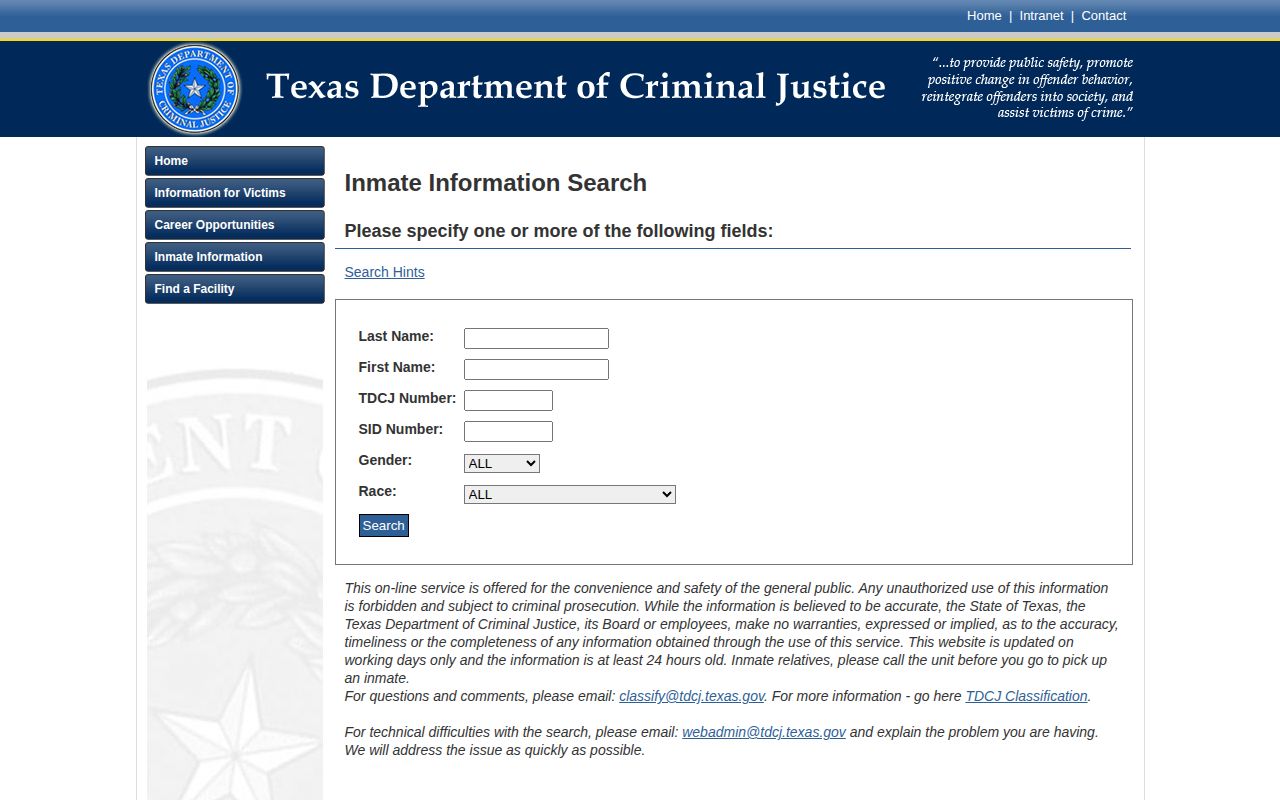
- Confirm that TDCJ, rather than Leon County Jail, currently holds the person.
- Search by TDCJ or SID number when available. Otherwise use the exact name and compare the case details.
- Read the projected date beside the sentence, offense, county, and parole-review information.
- Note the date and time checked because the record can update later.
- Use the official alternative request route if the online record is missing or unclear.
A missing result may mean discharge, but it may also reflect a name mismatch, data lag, or another custody system. It does not prove release by itself.
TDCJ Email Release-Date Route
TDCJ offers a no-charge inmate-information email service when the public search does not answer the question. Its official instructions ask for identifying information and explain that a projected release date assumes no earlier parole. The response route is useful when a current detail is hard to locate or requires clarification.
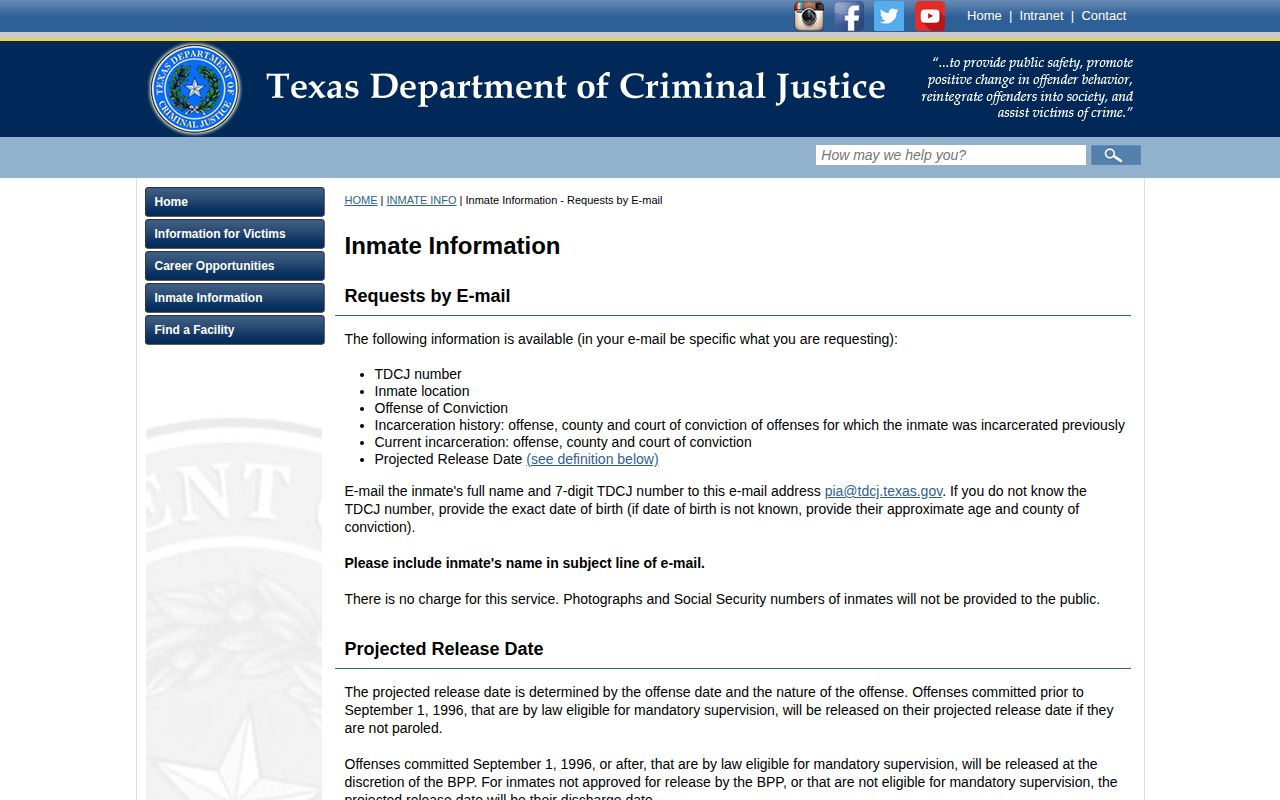
Provide the full name, TDCJ number, and date of birth when known. Ask for the maintained release information rather than a sentence calculation. This email service does not supply photographs. Formal TDCJ Public Information Act requests use a different channel and may be needed for older release records after a person drops from current-inmate results.
Leon County Jail Has No Calculator
A person held only at Leon County Jail does not receive a TDCJ projected date. Pretrial custody has no sentence-based release day. Release may follow bond, a court order, dismissal, another case outcome, or transfer. A person serving a county-jail sentence must be checked through the judgment, jail-time credit, and Sheriff records.
Leon publishes no local good-time calculator, weekend-release rule, or sentence-computation policy. Do not apply TDCJ Chapter 498 classifications to a county misdemeanor term. Request the signed judgment and credit from the correct clerk, then ask the Sheriff for the actual book-out. District Clerk handles felony district cases; County Clerk handles misdemeanor county matters.
| Situation | Date source | What it proves |
|---|---|---|
| Pretrial jail custody | Bond or court order plus Sheriff status | Authority and current execution |
| County-jail sentence | Judgment, credit, and book-out | Sentence terms and actual departure |
| TDCJ sentence | TDCJ detail and CID Records | Current state projection |
| Transfer | Sheriff destination and receiving agency | Continued custody, not community release |
Texas Good Time Is Not 85 Percent
Texas Government Code Chapter 498 governs state-prison good-conduct classifications, accrual, forfeiture, and restoration. Good time may affect eligibility for parole or mandatory supervision where the law permits. It does not shorten the court’s sentence on its face, and it does not guarantee release. Discipline can lead to forfeiture, while restoration is controlled by law and policy.
Texas has no universal rule requiring every inmate to serve 85 percent. That common claim should not be used to estimate a Leon case. Government Code Section 508.145(d) instead applies a specific half-time calculation to listed serious offenses and qualifying deadly-weapon findings. Actual calendar time, without good-conduct time, must equal one-half of the sentence or 30 years, whichever is less, with a two-year floor and other provisions. Different offenses and dates follow different rules.
Section 508.149 separately lists mandatory-supervision exclusions. Older “3g” language now corresponds to references in Code of Criminal Procedure Article 42A.054. None of these rules creates a safe universal calculator. Eligibility means a case may be considered; it is not release, approval, or a scheduled book-out.
Why Leon Release Dates Change
A TDCJ projection can change for several distinct reasons. The date should always be read as of the day it was checked. When a large move appears, request confirmation instead of assuming the first result was wrong.
| Factor | Possible effect | Best follow-up |
|---|---|---|
| Good-time status | Eligibility or projection may move | Ask TDCJ CID Records |
| BPP decision | Earlier release or later review may result | Use BPP status and TDCJ record |
| New sentence | Recalculation may be required | Check signed judgment and TDCJ audit |
| Detainer or hold | Community release may become transfer | Identify the receiving agency |
| Program or residence step | Approved parole may await processing | Confirm scheduled unit/date with TDCJ |
| Audit correction | Recorded credit or date may change | Request current official information |
Concurrent or consecutive sentences, court credit, and statutory exclusions can also matter. Only the responsible records office can apply them to the individual case.
Parole Review Before Leon Release
A parole-review date is not the projected release date. TDCJ CID Records calculates eligibility, then BPP reviews and votes where authorized. An approval may still require a program, approved release plan, certificate, and records audit. A denial may set another review date. These stages explain why “approved” should never be rewritten as “released.”
The Leon County parole and probation path separates state parole from local community supervision. If the person received probation from a Leon court, use the signed order and Adult Probation office. If the person is still in TDCJ, use the state record. The original Leon County Jail departure may have been a transfer long before either event.
Confirm a Leon Release Date
Use notification as an alert, then obtain an agency record. Texas IVSS-Counties is the county route for a specific Leon detainee, while TDCJ IVSS covers state custody and parole or mandatory supervision. Notifications can arrive near an event but are not official records and do not guarantee timing.
- For Leon County Jail, request the Sheriff’s release or book-out date, time, type, and destination agency.
- For TDCJ, retain the projected result, then obtain actual release information after the event.
- For a court-authorized release, request the signed order as well as the custodian’s execution record.
- For a transfer, verify the receiving facility before describing the person as back in the community.
- For an old event, use formal records channels because current searches may no longer show the person.
The Leon County released-inmate search path brings these sources together. Two records often answer the question best: the legal authority and the custodian’s completed release entry.
Read Leon Date Examples Safely
Suppose a current TDCJ detail shows a projected date next year and a parole review before it. The sound reading is that CID Records currently projects release by that date if parole does not occur sooner, subject to legal and status changes. It is not safe to announce the date as guaranteed or infer a fixed percentage served.
If a mandatory-supervision-eligible case receives a BPP denial, the projected date may be recalculated toward maximum expiration or discharge. A later approval can move it earlier so release processing can begin. The changing field does not prove the earlier record was false. It shows that the state calculation responded to a new legal status.
For a person serving only a Leon County misdemeanor jail sentence, none of those state examples supplies a date. The Leon court judgment and Sheriff custody records control that episode. The same is true when a person leaves the jail for TDCJ: the local book-out is the transfer date, while the TDCJ projected date concerns a later possible exit from state custody. Keeping the two dates labeled prevents a transfer from being mistaken for community release.
Public Record Search
Sponsored Results